

Your time30 minutes
Covered
Egg Freezing Consult
An initial consultation with one of our fertility specialists. We review your full history, your goals, and your timeline. No referral needed.
Our services · Egg freezing
Freezing your eggs preserves the fertility you have today. The timing of family-building becomes yours, not your biology’s. No referral needed and AI-assisted CHLOE™ OQ scoring on every cycle.
Understanding Egg Freezing
Egg freezing retrieves eggs from your ovaries and flash-freezes them through vitrification, a method that preserves them for the long term. When you’re ready to use them, your eggs are still the age they were when frozen, not the age you are then. Most patients complete one to three cycles to reach their target. The biological pause that lets you decide later.

How Many Eggs
The right number depends on your age at freezing and how confident you want to feel about using these eggs down the road. As a general guide:
Guideposts, not hard rules: your specialist will tailor a number to your AMH, history, and, most importantly, your goals. You’re not in this alone.
Want to model your own scenario? Try our Egg Freezing Calculator. Peer-reviewed estimates based on your age and egg count.
Try the Calculator
The Process
Nine steps across three phases. From consult through retrieval to long-term storage.
An initial consultation with one of our fertility specialists. We review your full history, your goals, and your timeline. No referral needed.
Ovarian reserve testing with AMH and antral follicle count. AMH is not covered by OHIP or MSP. All testing happens at our clinic.
Your specialist designs a stimulation protocol built specifically for you, based on your age, AMH, and history. We walk through medications, schedule, costs, and what to expect day by day.
We confirm your start date based on your cycle, your protocol, and any priming your specialist recommends (estrogen, birth control, or none). Many patients begin stimulation directly; some have a brief priming phase to optimize timing and ovarian response.
You shouldn’t have to wonder what you’ve actually banked. CHLOE™ OQ uses AI, trained on more than 54,000 eggs, to score every mature egg in your cycle from 0 to 10. The higher the score, the more likely that egg is to develop into a blastocyst (an early embryo stage that can be transferred into the uterus).
Why Twig
Six things that show up across every cycle, every patient, every clinic.

A team of fertility specialists who guide you through every step. You’ll know everyone on your team by name.
Meet the team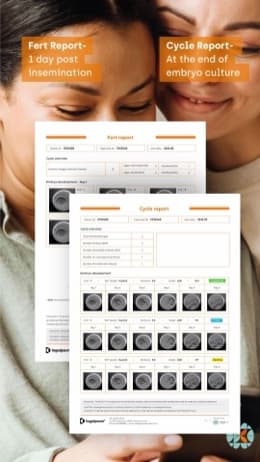
Our CHLOE-equipped lab gives you a per-egg quality score and a personalized future embryo development probability. The first clarity most patients get on what they are preserving.
See CHLOE™ OQ
Heated robes and slippers, private changerooms, and a recovery suite with snacks. Your cycle is medical. The space around it is restorative.
See our spaces
Storage is included for the first year. Use your eggs when you’re ready, whether that’s in three years or thirteen. Your future partner, donor, or solo plans can all wait for you, not the other way around.
How storage works
Toronto patients monitor at Midtown or Downtown in the PATH, with retrievals at Midtown. Vancouver patients have a full clinic on the West Coast.
Find your clinic
Same intake, same care, every form of family. Whether you’re freezing for medical, career, partnership, or LGBTQ2S+ reasons, the process and the people are the same.
LGBTQ2S+ family buildingPricing
Honest pricing, confirmed before your cycle starts.
Does not include medications and egg storage beyond year one.
Per year.
We offer long-term cryo-storage packages as well. Please ask your care team and they can provide you with more information.
Tax Credit
Ontario residents benefit from a refundable tax credit covering 25% of eligible fertility-related expenses incurred each calendar year. Egg freezing, medications, and storage all qualify.
Eligible expenses include egg freezing cycles, fertility medications, cryostorage fees, travel expenses, and diagnostic testing.
Federal credit: The Medical Expense Tax Credit (METC) may also apply to many of these expenses. Consult your accountant for personalized advice.
Does not include medications and egg storage beyond year one.
Per year.
We offer long-term cryo-storage packages as well. Please ask your care team and they can provide you with more information.
Many employers now offer fertility benefits, including egg freezing. Twig also works with Progyny, Carrot, and other fertility benefits providers. Check with your HR or benefits provider to see what’s covered.
Any add-on is reviewed and confirmed with you before it’s added to your cost.
Need help spreading the cost? Financing is available through Humm on every cycle.
Your Care Team
Fellowship-trained REI specialists design your plan and oversee every cycle. Your nurse practitioner manages your day-to-day care: monitoring appointments, medication adjustments, and the questions that come up.
Common Questions
Egg freezing (also known as oocyte cryopreservation) is a fertility preservation technique that involves retrieving eggs from your ovaries, freezing them, and storing them for future use. At Twig Fertility in Toronto and Vancouver, we use advanced vitrification technology to preserve your eggs until you’re ready to start your family. The process can take approximately 2 to 3 months from consult to completion. It begins with a consult and diagnostic testing, followed by a preparation month, an 8 to 12 day period of ovarian stimulation with injectable fertility medications, a short procedure to retrieve the eggs, and egg freezing and storage.
An egg freezing cycle at Twig is $8,600 in Toronto and $8,800 in Vancouver. That includes your initial egg freezing consult, dedicated care team, cycle coordination, all monitoring (bloodwork and ultrasounds), the egg retrieval procedure, egg freezing, your CHLOE™ OQ Report, and the first year of egg storage. Medications are billed separately (typically $4,000 to $7,000 depending on protocol). Ongoing cryostorage after the first year is $800/year in Toronto and $900/year in Vancouver. Ontario residents may also benefit from the Ontario Fertility Tax Credit, which covers 25% of eligible expenses. Full pricing is available on our pricing page.
From the start of stimulation medications to the egg retrieval procedure, most cycles run two to three weeks. From your initial consult to retrieval, plan for two to three months including testing and a priming month.
Egg quality and quantity decline with age, especially after 35. Many people choose to freeze their eggs in their late 20s or early/mid-30s; however, we welcome patients until age 43. Your fertility specialist will give you an individualized recommendation based on your age, AMH and history.
The egg retrieval process is done under conscious sedation, meaning that you are given pain medications through an IV for the duration of the procedure. You are also given IV medications that make you more sleepy and relaxed. These medications are not a general anesthetic, so you can expect to be aware and to feel pressure from the ultrasound during your procedure. The majority of people’s pain is very well controlled with these medications during their procedure. Afterwards, you can expect some cramping and bloating.
No. Egg freezing does not reduce your ovarian reserve or ‘use up’ any of your future eggs. The eggs that are retrieved in a cycle are those that would naturally have been lost during that menstrual cycle.
The quantity and quality of eggs decline over time, accelerating after the mid-30s. Eggs from older people have a higher chance of having chromosomal abnormalities, leading to lower pregnancy rates and higher risks of early pregnancy loss. For this reason, your fertility specialist may recommend freezing more eggs if you are older, in order to maximize your chances of achieving your future reproductive goals.
Egg freezing is for anyone who wants to preserve the option of biological children for later. Patients freeze eggs for career timing, partner timing, medical reasons (chemotherapy, surgery, gender-affirming care), or simply to keep options open. There is no single ‘right reason’ to freeze.
With modern technology, eggs can remain safely frozen for many years. Studies have shown that eggs frozen for over a decade can still result in healthy pregnancies. Your eggs are stored in our on-site cryostorage tanks with RI Witness electronic tracking and routine monitoring.
Once your eggs are retrieved, a Twig embryologist counts and then freezes them using vitrification. They are then stored in specialized tanks full of liquid nitrogen and can remain safely stored indefinitely until you are ready to use them.
Yes. Whether you have a hormonal or copper IUD, it will not interfere with your ability to freeze your eggs and it does not have to be removed. If you have a hormonal IUD and do not get periods, we will arrange for visits to the clinic to ensure you are starting your cycle at an optimal time.
The right number depends on your age and your goals, not a single target. As a general guide: under 35, 10 to 15 mature eggs make a solid starting reserve; from 35 to 37, around 15 to 20 or more gives good footing; and at 38 and older, we usually build toward 20 or more, often across more than one cycle. These are guideposts, not hard rules. Your specialist will tailor a number to your AMH, history, and goals. To estimate your own chance of a live birth by age and egg count, try our Egg Freezing Calculator, built on peer-reviewed data from Cobo (2016) and Doyle (2016).
No waitlist · No referral
No referral necessary. We can't wait to meet you.