

Your time30 minutes
Covered
Family Building Consult
An initial consult with one of our fertility specialists. We review your full history, your priorities, and the family you want to build. No referral needed.
Our services · In vitro fertilization
At Twig, every step of IVF, from your first consult to embryo transfer, happens in our clinic, with our team, in our lab.
Understanding IVF
IVF retrieves eggs from your ovaries, fertilizes them in our embryology lab, and grows them into embryos. One embryo is then transferred to your uterus.
“The most effective form of assisted reproduction.”
What cycle monitoring looks like
Once your cycle begins, you’ll come in every one to three days for a short visit: an internal ultrasound to track follicle growth, and bloodwork to check your hormone levels. A Twig fertility specialist reviews every result the same day, and your nurse follows up through the patient portal with your next steps.

The Process
Three phases. Timing varies based on your cycle and care plan.
An initial consult with one of our fertility specialists. We review your full history, your priorities, and the family you want to build. No referral needed.
Hormone bloodwork, AMH, antral follicle count, and sonohysterogram. And a semen analysis, if applicable. AMH is not covered by OHIP or MSP. Sonohysterograms and semen analyses are not covered by MSP. All testing happens at our clinic.
Your specialist designs an IVF protocol built specifically for you, based on your results and history. We walk through medications, appointment schedule, costs, and what to expect day by day.
One to four weeks of medication before ovarian stimulation begins. Your priming will be individualized based on your history and test results. Medications may include estrogen, birth control pills, or other medications.
Our Embryology Lab
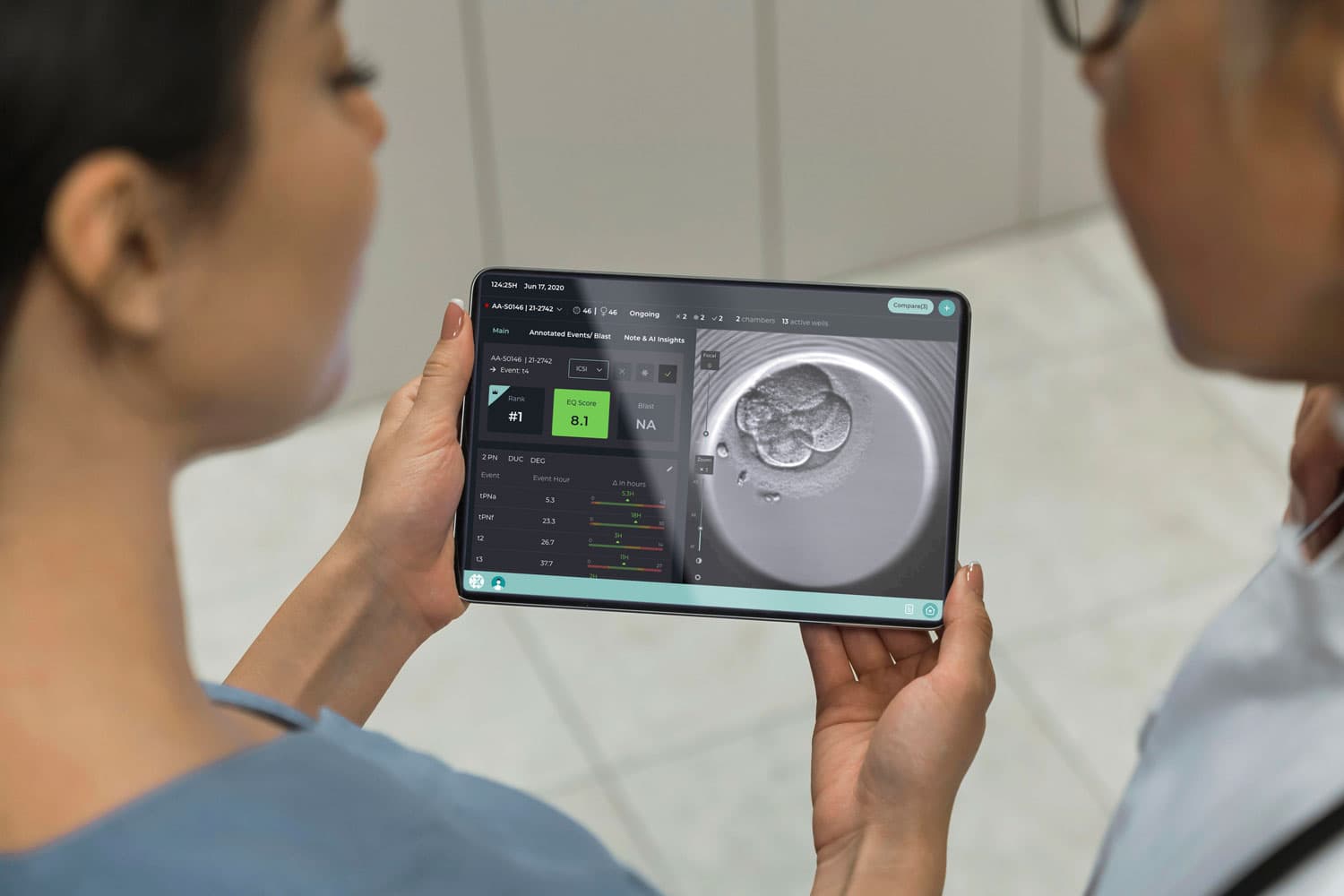
What happens in the lab has a big impact on your cycle outcome. Our embryology lab pairs the most advanced reproductive technology available with experienced, certified embryologists, led by a Chief Scientific Officer who has built IVF labs on four continents, across two of our modern fertility facilities.
You’re not a bystander in your own treatment. From the day your eggs are retrieved to the day of transfer, your embryos are cared for in our own on-site lab, and you can follow their development day by day from your phone. Every egg, sperm, and embryo is verified electronically at each handoff, so you always know exactly what’s happening.
CHLOE™ EQ Reports provide scores for your embryos after fertilization. These scores predict the future implantation potential of your embryos.
Watch your embryos develop day by day on your phone. Realtime footage of your own cycle, with the same view our embryologists use.
Objective embryo quality scores generated from millions of timelapse data points. A second opinion that helps inform your transfer decision.
Embryos are photographed every ten minutes for five to seven days without leaving the incubator. Stable temperature, stable atmosphere, no disruption.
The top grade of air filtration, standard on every Twig cycle. Removes volatile organic compounds and particulates that can compromise embryo development.
Every sample, every transfer, every embryo electronically tracked from retrieval to transfer. No paper labels. Designed to eliminate human-error mix ups.
Led by a Chief Scientific Officer who has shaped IVF labs across four continents. Our embryology team is trained to those same standards in Toronto and Vancouver.
Step into our embryology lab, meet the team, see the tools, watch a cycle from inside the dish.
Tour the LabWhy Twig

Care Team
Fellowship-trained REIs, dedicated nurses, embryologists, and genetic counsellors who guide you through every decision. Compassionate, experienced, available to you.
Meet the team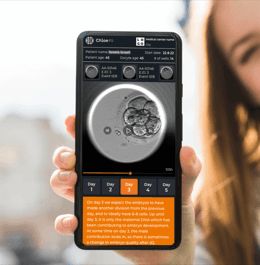
Lab Transparency
Through CHLOE™ Embryo Viewer you can watch your own embryos develop on your phone, and the CHLOE™ EQ Report gives you their AI-assisted quality scores.
Tour the lab
OFP Funded
Eligible Ontario patients begin their funded IVF cycle the same month they enrol. Twig is one of the few clinics with zero waitlist for OFP.
Check eligibility
Connected Care
Toronto patients monitor at Midtown or Downtown in the PATH, with retrievals and transfers at Midtown. Vancouver patients have a full clinic on the West Coast. Same protocols, same standards.
Find your clinic
Genetics
Our counsellors walk you through carrier screening, PGT results and much more. Testing happens through certified partner labs. Counselling stays with us, end to end.
Learn more about Genetic Counselling & Testing
Family Building
Reciprocal IVF, donor egg and sperm, gestational surrogacy, single parents by choice, and LGBTQ2S+ families. Built into how Twig works, not added on.
Learn more about LGBTQ2S+ Family BuildingPricing
Honest pricing, confirmed before your cycle starts.
*For eligible patients. Does not include medications, storage, and optional add ons like PGT.
Does not include medications, storage, and optional add ons like PGT.
Per transfer. Does not include medications.
Plus $365 per embryo biopsied.
PGT-SR and PGT-M priced on request.
Tax Credit
Ontario residents benefit from a refundable tax credit covering 25% of eligible fertility-related expenses incurred each calendar year. IVF, medications, embryo transfer, genetic testing, and storage all qualify.
Eligible expenses include IVF cycles, fertility medications, embryo transfer (FET), PGT-A genetic testing, embryo storage fees, travel expenses, and diagnostic testing.
Federal credit: The Medical Expense Tax Credit (METC) may also apply to many of these expenses. Consult your accountant for personalized advice.
Does not include medications, storage, and optional add ons like PGT.
Per transfer. Does not include medications.
Plus $365 per embryo biopsied.
PGT-SR and PGT-M priced on request.
BC offers government funding, but Twig does not yet have access to the program. We are actively monitoring program details and will apply to participate as soon as we are able. In the meantime, financing options are available.
Many employers now offer fertility benefits, including IVF. Twig also works with Progyny, Carrot, and other fertility benefits providers. Check with your HR or benefits provider to see what's covered.
Any add-on is reviewed and confirmed with you before it’s added to your cost.
Need help spreading the cost? Financing is available through Humm on every cycle.
Your Care Team
Caring, fellowship-trained fertility specialists who guide you through every decision. Compassionate. Experienced. Available to you across our Toronto and Vancouver clinics.
Common Questions
IVF is a common and effective treatment for helping people build their families. It is an option for couples facing fertility challenges due to conditions including, but not limited to, blocked or damaged fallopian tubes, low sperm counts, endometriosis, recurrent pregnancy loss, and advanced age. IVF is also used to help single people and couples build their families with the help of donor eggs, donor sperm, or a gestational surrogate.
While every situation is unique, the basic components of an IVF cycle include: preparation, ovarian stimulation, egg retrieval, fertilization, embryo culture, embryo freezing, and embryo transfer. Your personalized care plan will be provided at the start of your cycle to guide you through this journey.
Timing varies based on your individual care plan. Diagnostics, planning, and cycle prep happen over the weeks leading up to your treatment cycle. Your fertility specialist will walk you through the timeline that fits your situation.
Cycle monitoring is a series of blood tests and internal ultrasounds performed over the course of 9 to 13 days following the start of your fertility medications. Cycle monitoring is used to track your progress during your IVF cycle and determine the optimal timing for your egg retrieval procedure.
IVF relies on fertility medications called gonadotropins (FSH and LH) to stimulate your ovaries to produce multiple eggs at the same time. These medications are essential to the IVF process.
The egg retrieval process is done under conscious sedation, meaning you are given medications for pain and relaxation through an IV for the duration of the procedure. These medications are not a general anesthetic, so you can expect to be aware and to feel pressure from the ultrasound during your procedure. The majority of people find that their pain is very well controlled with these medications during their procedure.
Conventional IVF and ICSI are two methods of fertilization when doing an IVF cycle. With conventional IVF, sperm is washed and prepared and then placed around each egg to allow fertilization to happen naturally. ICSI stands for intracytoplasmic sperm injection. It is a technique where a single, motile, normally shaped sperm is injected directly into each mature egg to achieve fertilization. Your team will recommend the best approach based on your situation.
Timelapse incubation is the process of incubating, or growing, your embryos in a specialized incubator equipped with cameras that take photographs of your developing embryos around-the-clock. This technology means that our embryologists can continuously monitor the development of your embryos in a controlled environment without removing them from the incubator. At Twig, this footage is available through the CHLOE™ Embryo Viewer, included on self-pay cycles and available as an add-on for OFP-funded cycles, giving you transparency and insight into your embryos’ growth.
An embryo transfer is the process of placing an embryo into the uterus in the hopes of achieving a pregnancy. Embryo transfers can be fresh or frozen. Fresh transfers occur either 3 or 5 days after an egg retrieval or egg thaw procedure. Frozen transfers involve thawing a previously frozen embryo and aligning the timing of the transfer with preparing your uterus for implantation.
In most cases, we transfer one embryo at a time. This is the preferred approach to reduce the risk of multiples and pregnancy complications while optimizing outcomes. In very select cases, we may consider transferring two embryos at the same time after a thorough discussion of risks with your fertility specialist.
Embryos that are not transferred during an IVF cycle can be cryopreserved (frozen) for future use. At Twig, any fully developed embryos that are not used are frozen and stored in our lab. This allows you to use them in a future embryo transfer cycle.
Pregnancy rates after IVF vary significantly by age, diagnosis, and cycle type, so a single headline number can be misleading. At Twig, your physician will share outcome data relevant to your specific age range, diagnosis, and treatment plan at your consult, and we reference national CARTR-BORN data alongside our own results.
Not every cycle results in a pregnancy, and we don’t pretend otherwise. If a cycle doesn’t reach your goal, your specialist will sit down with you to review what happened, what we learned, and the options for moving forward. Many patients try again with adjustments; some patients consider other paths. The choice is yours.
Eligible Ontario residents under 43 are eligible for one government-funded IVF cycle through the OFP. At Twig there is currently no waitlist. Additional cycles are self-pay. In BC, consults are MSP-covered and IVF is self-pay.
Our IVF cycle price does not include fertility medications (approximately $4,000 to $8,000+ depending on the specific protocol and dose required), the embryo transfer itself, PGT-A genetic testing, or embryo storage beyond the first year. Your care team will walk you through every cost during your planning visit.
No waitlist · No referral
No referral necessary. We can't wait to meet you.
